
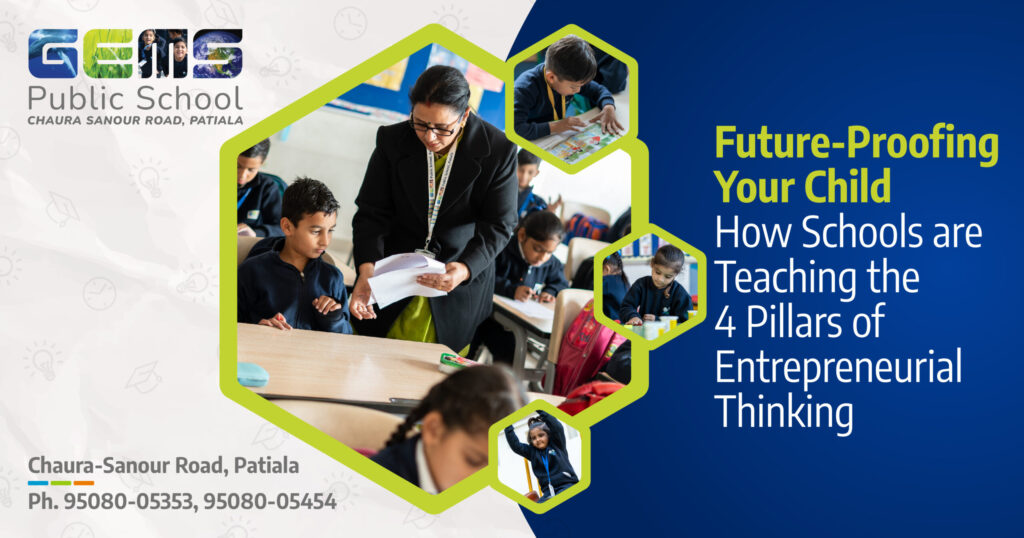
Future-Proofing Your Child: How Schools are Teaching the 4 Pillars of Entrepreneurial Thinking
In today’s growing and changing world, the measure of success has evolved from focusing solely on academic or professional successes to emphasizing creativity, critical thinking, and innovation. These, in turn, represent the key characteristics associated with a mindset or attitude that is entrepreneurial in nature. Teaching these qualities to children from a young age would help them better for the increasing challenges associated with a growing and changing world, where adaptability and creativity would be highly valuable. The next question would be, what’s the key to encouraging a sense of entrepreneurship in children? This would involve looking at how they learn, play, and see things around them in a different, innovative way. Why Entrepreneurial Thinking Matters in Early Childhood? Entrepreneurial thinking is even more than business acumen and entails characteristics like resilience, initiative, leadership, problem-solving, and risk-taking. By being introduced to the concept of entrepreneurial thinking, kids can learn to venture out into ideas with freedom, make their own decisions, and believe in their own capabilities. Studies have found that kids are more open to skill-building during childhood. Encouraging innovation and independence among kids not only enhances their intellectual development but also instills the crucial attributes of emotional and people skills in them—the basics needed to make the next set of trailblazers. Skills Acquired by the Students through Entrepreneurship Creativity: This is the skill of being able to think beyond the structured patterns. This skill involves being innovative. Leadership: The skill of influencing other people towards a common goal. Resilience: Realization that Failure is a Key Success Pathway. Problem-Solving: The skill of attacking everyday problems with assurance and a well-thought-out plan. In our best international school in Patiala, we firmly believe in the fact that the future belongs to those who are able to adapt quickly, work in teams, and be creative. However, no matter what the profession or the goal of your child, it merely serves to be a catalyst in order to be innovative and creative. Entrepreneurship in the learning process of the students at our best CBSE school in Patiala, GEMS Public School. The Four Pillars of Education For Entrepreneurial Thinking In this ever-changing global setting, the role of education must transcend the content-oriented approach, working towards fostering more adaptable, resilient, and ‘future-ready’ students in their academic rigor. The Four Pillars of Education, designed by UNESCO, form a broad spectrum that can be employed in this pursuit. The Foundation of Education has four capital letters: 1. Learning to Know, 2. Learning to Do, 3. Learning to Live Together, and 4. Learning to Be. 1. Learning To Know A System for Theory Development Therefore, “Knowing to Learn” carries the learning process further, as knowledge acquisition that happens at this stage provides the learner with the essential skills required to learn. This pillar lays emphasis on knowledge acquisition, skills development, and applying those skills to learn. It’s about cultivating a hunger to learn, to discover, and to explore, making the learner ready to adapt to any situation at any given time. Strategies for Implementation: Integrated Curriculum: By emphasizing the integration of study areas, the process of linking concepts from different areas of study helps the student gain greater insight. Critical Thinking Exercises: Problem-solving assignments and analytical discussions are regarded as a process that engages the students in developing their critical thinking skills and also teaches them how to find solutions to problems. Attitude Toward Lifelong Learning: This is a process that gradually seems to be creating a thirst for knowledge and a devotion to learning that finally opens the door of lifelong learning for the students. 2. Learning to Do Application of Knowledge And Skills As the world requires practical know-how, “Learning to Do” recognizes the need to implement knowledge in practical activities. This concept recognizes the acquisition of skills, which include technical skills, with the objective of ensuring employment potential. Group work or internship opportunities allow students to take their classroom knowledge and put it into action. Students then develop the skills to apply it to real life. This pillar focuses on creating opportunities for experiential learning. Strategies for Implementation: Experiential Learning: Students can gain hands-on experience through a project, an internship, or an apprenticeship where they will apply the knowledge they learned. Training Based on the Development of Specific Job-Related Skills: There are courses dedicated to teaching coding, communication, and problem-solving that help prepare students for the workforce. Soft Skills Training: Skills such as teamwork, flexibility, and communication are considered very important; hence, they should be part of the curriculum. 3. Learning to Live Together Fostering Peace, Tolerance, and Cooperation “Learning to Live Together” is a concept that has great significance in today’s world, where people’s unity and understanding have become the key factors to success. Social Skill Development and Cultural Awareness: Encouraging students to understand diversity, learn from each other, and resolve conflict peacefully is the basis on which we build a foundation for positive social skills that will allow students to maintain positive relationships both in their personal and professional lives. Strategies for Implementation: Diverse Learning Environments: Spending time among classmates from various backgrounds helps the learners to understand and appreciate the importance of cultural diversity. Conflict Resolution Workshops: Workshops in conflict resolution teach such skills as promoting respect and supporting one another, which are very effective. Global Citizenship Programs: Students will develop awareness of issues related to taking care of our planet and being responsible citizens. 4. Learning to Be Facilitating Personal Growth and Self-Discovery The most crucial of the four pillars has been “Learning to be,” which is associated with personal development and self-discovery. This skill helps students to become aware of themselves and builds strength and character within them. This pillar emphasizes the value of self-confidence and creativity so that students can live full and meaningful lives and contribute fully to society. This pillar also correlates significantly with the fourth pillar that has just been highlighted—Spirituality within Education, which gives importance to the individual’s growth through experiential learning. Strategies for Implementation: