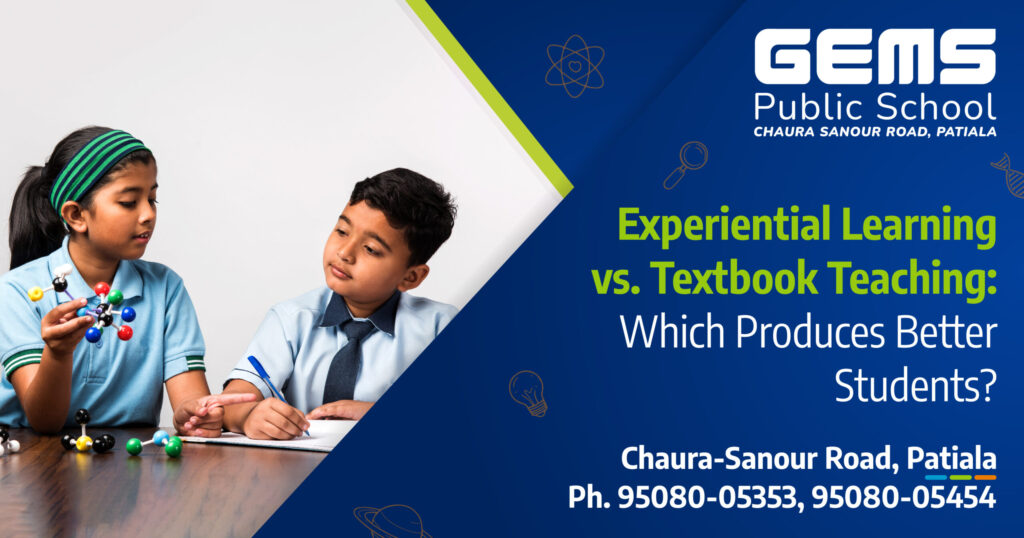
The 21st century is marked by a rapidly changing landscape that affects all fields, including education. Education itself has its defined confines as well, but it far exceeds textbooks. People should focus more on learning from real life than books because it involves learners in practical experiences, which help them relate to concepts and apply theoretical knowledge.
What is Experiential Learning?
As we know, Experiential Learning is an immersive form of learning beyond classical textbook-based education. This philosophy sort of circles around a practical and field-tested mode of “learning by doing,” which not only plants the students in real-life experiences but also shows how well you can put the theoretical knowledge to work in a more productive, useful manner. In other words, it’s learning beyond books, you know, not only for the page through interactive methods such as role-playing, experiments, and field trips. By forcing students to participate in the process, it creates a naturally learning-friendly environment.
This model combines classroom learning with application to real-life settings, encouraging students to practice translational science. A local environmental undergraduate performing a cleanup would capture this as they learned more about conservation than ever from merely reading textbook citations. Besides, the experiential learning cycle teaches students to reflect and be critical thinkers about what they have practiced, with links to theoretical knowledge from textbooks. Yes, now experiential learning understands and helps to address individual learning styles. This method of teaching outside the textbook enables students to understand and retain information in a manner that suits their natural learning process (visual, auditory, or kinesthetic).
Therefore, the power of an experiential learning approach is in creating a well-rounded educational framework that goes beyond textbook content and enables thorough concept comprehension, subsequently making students relatively industry-ready.
Advantages of Experiential Learning
A Cognitive Approach
Whereas the learning horizon is the extent of the educational realm, which can be broadened by immersing! But in this other model of education, it allows an interactive approach with the material, as students are pushed to ask questions, explore, and find answers. By prioritizing concept understanding over memorization, textbook-free learning promotes critical thinking and problem-solving, which should be a core competency of modern learners.
Encouraging Creativity and Innovation
Besides, learning beyond books has a hands-on method, which helps grow creativity and innovation. The students interact with scenarios that exist in the real world, applying their knowledge in a unique way in order to solve these issues. This means learning in a manner that is beyond textbooks builds creativity and innovation, which are among the most desired skills of manufacturers.
Catering to Diverse Learning Styles
Moreover, one more positive thing about this process is An inclusive way! Adapted to accommodate visual, auditory, and kinesthetic learners, learning beyond books. This is where teaching beyond the textbook comes in: as traditional textbook-based learning may not be enough for students who learn differently, teaching beyond the textbook emerges; it utilizes many methodologies and gives all learners a chance to succeed in an academic environment.
Preparing Students for the Future
How does every single thing you mention correlate to experiential learning, which prepares students (indirectly) for a complex and unpredictable real world that our kids are going to be stepping into? Unlike theoretical knowledge from textbooks, projects and internships give you practical experience. It not only enhances their knowledge of the subjects but also helps them gain soft skills such as teamwork, communication, and leadership. Hence, education outside of books makes balanced, active, and hands-on students ready for life.
Why Learning Beyond TextBooks Matters?
In a constantly changing world, the importance of learning outside textbooks is paramount. This educational system equips students not just for the success that they may have in an academic setting but also to walk through life beyond academics. Focusing on more than textbooks helps learners to develop skills required for real-world performance. This is about nudging critical thinking and problem-solving abilities, which are now even more crucial than before in this world that’s getting more and more complicated, every year. Learning isn’t just books and facts; it also deepens the heart of creativity and innovation, at least that’s how it feels, especially in a time where automation and artificial intelligence are changing everything.
Learning beyond textbooks supports diverse learners, and that helps make sure each student lands on their feet. Students get empowered by linking ideas from class with real-world practice, not just memorizing definitions. And arguably, most importantly, outside of the classroom, education builds employability skills, and it adds real experience. Outside of books, the 21st-century genius keeps training you, step by step.
By fostering critical thinking, innovation, inclusivity, student motivation, and readiness for the real world.
Teaching Beyond the Textbook
Going beyond books through practical learning requires a shift from conventional classrooms. It advocates a need to provide instruction beyond the textbook, which can be difficult but ultimately extremely gratifying. With this type of teaching, teachers are far more likely to serve as facilitators, encouraging students to discover concepts at their own or group pace.
Project-based learning can be an example of how a teacher goes beyond the book—teaching students to work on real-world problems. It may even include technology, providing students with hands-on experience using tools they will probably encounter in their future jobs. The more the school goes beyond the boundaries of teaching from textbooks, urging students to connect theory with practice, the better.
Out of Textbooks: Cases and Examples
One such example of what learning beyond textbooks looks like is the flipped classroom. In this model, students learn concepts at home through videos or readings and spend the class time working on projects and discussing. It is a creative way to learn outside the confines of books.
In addition, case studies—a staple of many business and law school classes—are another example of learning that goes beyond the textbook. They give students real-world scenarios and challenge them to use their knowledge to solve complex problems.
Conclusion:
Beyond books, the adaptation is not a new trend but rather an integral part of today’s education. They should be doing experiential learning and moving beyond the textbook to prepare pupils with 21st-century skills for a dynamic world. The evolution of education in the 21st century drives this point home even more, to strengthen the case for learning beyond textbooks.
The very premise of GEMS Public School, Patiala, is this: a crossroads between academic depth and applied relevance, providing students with learning that prepares them for their first job but also a lifetime.
Frequently Asked Questions
1. What is experiential learning?
Ans. Project-Based Learning: A form of experiential learning whereby students engage with a complex question and challenge through real-world or simulated projects, foregoing traditional types of learning methods based on lectures or teacher-centered techniques. It is about knowledge application, not just theoretical grounding. This method is the backbone of so many modern-age experiential learning programs.
2. What is traditional learning?
Traditional learning typically includes the structured, classroom-based approach, which is really based on lectures, textbooks, and exams. It is good for building theory and academia.
3. How are experiential learning and authentic learning different?
Experiential learning is based on learn-by-doing activities, and authentic learning entails solving real-world, meaningful problems. Authentic learning can encompass both, but is always set within context. The debate for experiential learning vs. traditional learning: both educate more than just passive learning.
4. What are the four steps of experiential learning?
These stages are having a concrete experience, observing and reflecting on it, developing abstract ideas, and then actively trying things out. Learners go through this process by doing something, thinking about it, learning from that, and then applying what they learned again. This cycle really shows what experiential learning means.
5. Can you explain the difference between Active Learning and Traditional Learning?
“Active learning” refers to a process where you participate, discuss problems, or work on projects, unlike traditional learning that is largely passive and lecture-driven. Traditionally, the use of active learning is often associated with experiential learning. Both highlight the departure of traditional learning versus experiential learning approaches.